Retinol CAS 68-26-8 | Anti-Wrinkle Cosmetic Raw Material – Baisfu
What the compound is
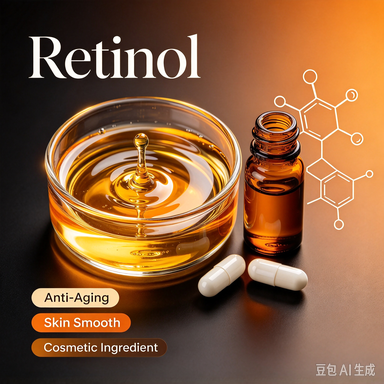
Retinol (CAS 68-26-8) is the alcohol form of vitamin A, a fat-soluble vitamin essential for vision, skin and immune function. It is the reference retinoid for cosmetic anti-ageing formulations, with a researched profile supporting epidermal renewal, collagen synthesis and wrinkle reduction; related retinoids include retinaldehyde, retinyl palmitate and the synthetic tretinoin.
Origin and production
Retinol is produced by chemical synthesis from beta-ionone or by molecular distillation of fish-liver oil, followed by purification and stabilisation. Baisifu offers synthetic and natural-source grades, stabilised as the free alcohol or as retinyl palmitate ester; the Statement of Origin identifies the production route and the grade.
Identity and assay
Baisifu standardises the material in-house by HPLC against a reference retinol standard; the standard assay grades are retinol 98 percent (HPLC) and retinyl palmitate 1.7 million IU/g (HPLC). The full isomer profile, including all-trans and 13-cis retinol, is recorded on each COA.
Physical behaviour
The material is a pale-yellow to yellow crystalline powder or viscous oil (retinyl palmitate) with a mild, characteristic odour; it is insoluble in water, soluble in ethanol, vegetable oils and organic solvents. The material is extremely light-, heat- and oxygen-sensitive and oxidises rapidly in the presence of air; the powder should be stored sealed under nitrogen, protected from light.
Applications
Retinol enters the following formulation workflows:
- cosmetic skin-care actives (anti-ageing and renewal)
- nutraceutical and dietary supplement softgels (vitamin A)
- functional-food and beverage fortification (oil-phase, as retinyl palmitate)
- pharmaceutical and clinical-research prototypes
- cell-culture and receptor-binding assay standards
Formulation notes
The all-trans isomer is the active form; the 13-cis isomer is less active. Retinol is oil-soluble and is formulated in the oil phase of emulsions or in softgel capsules; the compound is extremely unstable and requires antioxidants (BHT, tocopherol), opaque packaging and nitrogen-blanketing during processing. Retinyl palmitate is the stabilised ester form used in long-shelf-life formulations. Avoid co-formulation with strong oxidisers, acids and mineral acids; the conjugated polyene chain is sensitive to oxidation and isomerisation.
Certificate of Analysis
Each lot ships with a COA recording:
- retinol assay by HPLC
- all-trans and 13-cis isomer profile
- international units per gram (for retinyl palmitate)
- peroxide value and acid value
- heavy metals (Pb, As, Cd, Hg)
- microbial count and specified pathogens
Regulatory and handling
Retinol and retinyl palmitate are permitted cosmetic and food ingredients in most markets; the permitted use level varies, with restrictions on retinol in leave-on cosmetics in some markets. Vitamin A has an upper-intake limit for supplement use. Buyers are responsible for confirming the regulatory status of the finished formulation in the target market. Handle as an oil or powder with gloves and eye protection; avoid exposure to air, light and heat.
Packaging and storage
Supplied in sealed aluminium or amber-glass bottles, or in fibreboard drums with inner liner, under nitrogen, 1 kg, 5 kg and 25 kg net. Store in the original sealed container at 2 to 8 degrees Celsius or below, protected from light and air; the retest date is 12 months from manufacture when stored as recommended.
Questions
What is the difference between retinol and retinyl palmitate?
Retinol is the free alcohol form, the most active cosmetic retinoid. Retinyl palmitate is the ester form, more stable but requiring in-vivo conversion to retinol; it is used in long-shelf-life formulations.
Why is it so unstable?
The conjugated polyene chain (five double bonds) is extremely sensitive to oxidation by air, isomerisation by light, and degradation by heat. Use antioxidants (BHT, tocopherol), opaque packaging and nitrogen-blanketing.
Can it be used in cosmetics?
Retinol is a permitted cosmetic ingredient in most markets; some markets restrict the use level in leave-on products. Confirm the permitted use level and any required labelling with the target-market regulator.
Request a quotation
Send Baisfu the required retinol or retinyl palmitate standard and quantity, and the sales desk will reply with a current price, the lot fingerprint, packing option and lead time, with pre-shipment samples from the quoted lot.
Need specifications, COA, or a wholesale quote? Contact Us — typical response within 24 hours.