
Resveratrol CAS 501-36-0 | Botanical Extract Raw Material – Baisfu
What the compound is
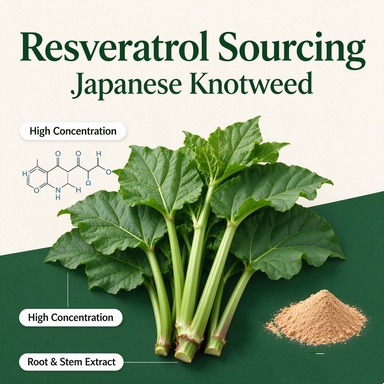
Resveratrol (trans-3,4′,5-trihydroxystilbene, CAS 501-36-0) is a stilbene polyphenol produced by plants as a phytoalexin in response to stress, wounding and fungal attack. The commercial standard is trans-resveratrol at 98 percent or 99 percent assay, isolated from the root of Polygonum cuspidatum Siebold & Zucc. (Japanese knotweed, Polygonaceae). Baisifu supplies the material as a botanical raw material for healthy-ageing, cardiovascular-support research and women-wellness formulations, with a full HPLC fingerprint on every lot.
Botanical source and production
Polygonum cuspidatum is a perennial rhizomatous herb cultivated and wild-collected in Gansu, Shaanxi and Hubei; the root is harvested in late autumn when the stilbene content peaks, then washed, sliced and dried. Baisifu extracts the root with aqueous ethanol, hydrolyses the polydatin (piceid) fraction to release the aglycone, and purifies the crude extract by macroporous resin and column chromatography followed by crystallisation. The Statement of Origin records the harvest region and whether the lot is cultivated or wild-collected so buyers can trace the raw material.
Identity and assay
Baisifu standardises resveratrol in-house by HPLC against a trans-resveratrol reference standard at 306 nm. The standard grade is 98 percent and 99 percent total resveratrol (HPLC, dry basis), with the cis-isomer and residual polydatin reported separately on each COA. Because cis-resveratrol has a different biological profile from the trans form, the isomer ratio is part of the release specification rather than a footnote. A 50 percent water-dispersible grade and a micronised grade are available for beverage and capsule applications.
Physical behaviour
The material is an off-white to light-beige crystalline powder with a very faint characteristic odour and a slightly bitter taste. trans-Resveratrol is poorly soluble in cold water (approximately 0.03 mg/mL) but freely soluble in ethanol, acetone and DMSO; it is light-sensitive and isomerises towards the cis form under prolonged UV exposure, and it degrades faster in alkaline media. Store sealed, protected from light, and keep formulations below pH 7 where possible.
Applications
Resveratrol enters the following formulation workflows:
- nutraceutical and dietary supplement capsules (healthy-ageing and antioxidant research)
- cardiovascular-support and metabolic-health research formulations
- women-wellness and skin-ageing functional blends (with isoflavones, vitamin C, CoQ10)
- cosmetic antioxidant actives for serums and emulsions
- functional-beverage and sachet prototypes (water-dispersible grade)
Formulation notes
Resveratrol is usually combined with phospholipids, cyclodextrins or a lipid carrier to improve oral bioavailability, and it is frequently co-formulated with vitamin C, vitamin E, CoQ10 or astaxanthin as an antioxidant stack. In capsules use the 98 percent crystalline grade with a glidant; in beverages use the water-dispersible grade and protect the finished product from light. Avoid co-formulation with strong alkalis and with oxidisers that shift the isomer ratio.
Certificate of Analysis
Each lot ships with a COA recording:
- total resveratrol assay by HPLC (trans plus cis, dry basis)
- trans/cis isomer ratio and residual polydatin
- identification by HPLC retention time and UV spectrum
- loss on drying, ash and heavy metals (Pb, As, Cd, Hg)
- residual solvents and microbial count with specified pathogens
- sieve analysis and bulk density
Regulatory and handling
Resveratrol is supplied as a botanical raw material for nutraceutical, functional-food and cosmetic formulation. It is not a drug and makes no drug-level claim. Buyers are responsible for confirming the regulatory status and permitted use level of the finished formulation in the target market. Handle as a fine powder with gloves and eye protection, and avoid dust generation.
Packaging and storage
Supplied in double-sealed food-grade polyethylene bags within fibreboard drums, 1 kg, 5 kg and 25 kg net. Store in the original sealed container at room temperature, dry, protected from light; the retest date is 24 months from manufacture when stored as recommended.
Questions
What is the difference between resveratrol and polydatin?
Polydatin (piceid) is the 3-O-glucoside of resveratrol and is the dominant form in the fresh root. During production the glucoside is hydrolysed to release the resveratrol aglycone; the residual polydatin is reported on the COA so buyers know how complete the conversion is.
Is the material natural or synthetic?
Baisifu supplies knotweed-derived natural resveratrol, not fermentation- or chemically synthesised material. The Statement of Origin and the HPLC fingerprint distinguish the two, and buyers requiring non-GMO or natural-origin declarations can request them with the quotation.
How should resveratrol be handled in capsule production?
Use the 98 percent crystalline grade, keep the blending room below 25 degrees Celsius and below 60 percent relative humidity, and protect the blend from direct light during and after encapsulation. Avoid prolonged exposure to alkaline excipients and to high shear that raises the blend temperature.
Request a quotation
Send Baisfu the required assay grade, isomer specification and quantity, and the sales desk will reply with a current price, the lot fingerprint, packing option and lead time, with pre-shipment samples from the quoted lot.
Need specifications, COA, or a wholesale quote? Contact Us — typical response within 24 hours.