
Fenugreek Extract | Herbal Raw Material – Baisfu
What the extract is
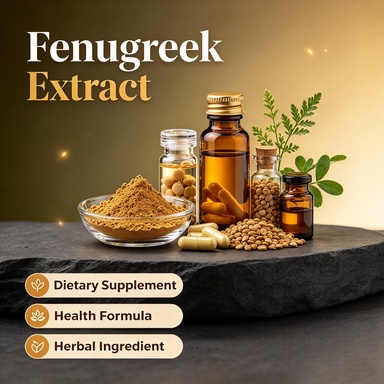
Fenugreek Extract is a standardised botanical extract prepared from the dried seeds of Trigonella foenum-graecum L., an annual herb of the Fabaceae family cultivated across China and India for both culinary and traditional use. The extract is characterised by its saponin fraction, dominated by diosgenin-precursor furostanol saponins, and by the alkaloid trigonelline; the two together account for the bitter, nutty, maple-like character of the raw seed and the researched metabolic and lactation-support profile of the extract.
Botanical source and harvest
Trigonella foenum-graecum is cultivated in Gansu, Inner Mongolia and Sichuan; the seeds are harvested at full pod maturity, threshed, cleaned and dried before extraction. Baisifu sources from established growing regions and the Statement of Origin identifies the harvest region and the seed-commodity grade so buyers can trace the raw material back to the field.
Active marker and standardisation
Baisifu standardises the extract in-house by HPLC-UV against reference markers; the standard assay grades are 50 percent total saponins (UV spectrophotometric) and 98 percent trigonelline (HPLC). The full saponin profile, including protodioscin and dioscin precursor peaks, is recorded on each COA, and the trigonelline figure is printed alongside the saponin assay so formulators can verify the dual-marker identity of the material.
Physical and sensory behaviour
The 50 percent saponin grade is a yellowish-brown to brown fine powder with a strong, characteristic fenugreek odour; the 98 percent trigonelline grade is an off-white crystalline powder with a milder, slightly bitter profile. Both grades are soluble in water and ethanol at typical use levels. The material is hygroscopic and should be stored sealed with desiccant.
Typical applications
Fenugreek Extract enters the following formulation workflows:
- nutraceutical and dietary supplement capsules
- functional-food and beverage formulations
- lactation-support products
- metabolic-wellness formulations
- traditional botanical formulations
- flavour modifier in savoury and spice blends
Formulation notes
The extract is soluble in water and ethanol and disperses in propylene glycol at typical use levels. The saponin content can produce foaming in solution, which is an advantage in beverage systems but may require defoaming in capsule and tablet wet-granulation. The maple-like odour of the saponin grade is strong; the trigonelline grade is preferred where odour neutrality is required. The material is stable under normal storage but should be protected from moisture.
COA and batch documentation
Each drum ships with a Certificate of Analysis carrying the HPLC chromatogram, total saponin assay, trigonelline flag, loss on drying, bulk density, heavy metals (Pb, As, Cd, Hg), pesticide residue screen and microbial count. An allergen declaration (cross-reactivity with peanut and soy), a Statement of Origin and a non-GMO declaration complete the pack, giving QC and regulatory teams a single-shipment document set.
Regulatory and compliance
Fenugreek is generally recognised as safe in food applications and is permitted as a dietary supplement ingredient in most jurisdictions. The allergen cross-reactivity with peanut and soy should be declared in markets where legume allergen labelling is mandatory. Under EU CLP the concentrated powder is not classified as hazardous, but standard Hazmat assessment should be performed for bulk movement.
Packaging, storage and supply
Fenugreek Extract is filled into 25 kg fibreboard drums with an inner double polyethylene liner and a desiccant sachet, sealed under COA. Store in a cool, dry, dark place away from direct sunlight and moisture; the recommended storage temperature is below 25 degrees Celsius with a shelf life of 24 months from manufacture in original sealed packaging. Baisifu ships ex-Xi’an, MOQ 1 kg for sample development and 25 kg and above for production orders; standard lead time 7 to 15 days depending on batch availability, with express air freight on request.
Questions buyers ask
What saponin and trigonelline levels can you guarantee?
The standardised grades are assayed to 50 percent total saponins (UV) and 98 percent trigonelline (HPLC) against reference markers; the exact figures and the full secondary fingerprint are printed on the COA of every drum.
Is the allergen cross-reactivity declared?
Yes. Fenugreek is a legume and carries cross-reactivity with peanut and soy; the allergen declaration shipped with each drum flags the applicable labelling requirement for markets where legume allergen declaration is mandatory.
Can you supply a deodorised grade?
The saponin grade carries a strong fenugreek odour; the trigonelline grade is preferred where odour neutrality is required. State the target sensory and we will advise the most suitable grade before you commit.
Request a quotation
Send Baisfu the required saponin or trigonelline grade and quantity, and the sales desk will reply with a current price, the lot HPLC fingerprint, packing option and lead time, with pre-shipment samples from the quoted lot.
Need specifications, COA, or a wholesale quote? Contact Us — typical response within 24 hours.