Eleutherococcus (Siberian Ginseng) Extract
What the extract is
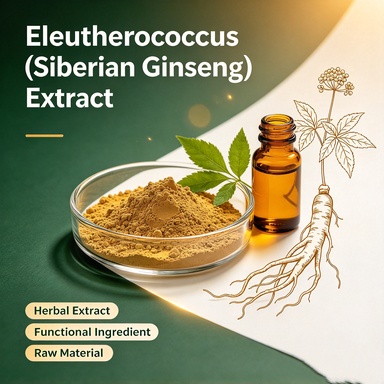
Eleutherococcus (Siberian Ginseng) Extract is a standardised botanical extract prepared from the dried roots and rhizomes of Eleutherococcus senticosus (Rupr. and Maxim.) Maxim., a perennial shrub of the Araliaceae family native to northeastern China and Siberia. The extract is characterised by its eleutheroside profile, principally eleutheroside B (syringin) and eleutheroside E, together with polysaccharides and phenolic compounds; the researched adaptogenic profile has made eleutherococcus a staple of tonic and anti-fatigue formulations worldwide.
Botanical source and harvest
Eleutherococcus senticosus is wild-harvested or cultivated in Jilin, Heilongjiang and Inner Mongolia; the roots are harvested from 3 to 5 year-old plants in autumn, cleaned, dried and sliced before extraction. Baisifu sources from established growing regions and the Statement of Origin identifies the harvest region and the wild or cultivated source so buyers can trace the raw material.
Active marker and standardisation
Baisifu standardises the extract in-house by HPLC against reference markers; the standard assay grade is 0.8 percent eleutheroside B (syringin), with total polysaccharides flagged as the secondary marker. The full HPLC fingerprint, including eleutheroside E and isofraxidin, is recorded on each COA so formulators can verify the botanical identity and the lot-to-lot consistency.
Physical and sensory behaviour
The extract is a brownish-yellow to brown fine powder with a faint, characteristic, slightly bitter odour; the material is soluble in water and ethanol at typical use levels and disperses in propylene glycol. The powder is hygroscopic and should be stored sealed with desiccant to suppress caking.
Typical applications
Eleutherococcus Extract enters the following formulation workflows:
- nutraceutical and dietary supplement capsules
- adaptogenic and anti-fatigue formulations
- functional-food and beverage systems
- traditional botanical formulations
- sports-nutrition products
- research and development
Formulation notes
The extract is soluble in water and ethanol and disperses in propylene glycol at typical use levels. The eleutheroside profile is heat-stable under normal processing conditions, making the material compatible with capsule, tablet and beverage formats. The powder is hygroscopic and should be stored sealed with desiccant; flavour masking may be required in beverage systems because of the bitter note.
COA and batch documentation
Each drum ships with a Certificate of Analysis carrying the HPLC fingerprint, eleutheroside B assay, polysaccharide flag, loss on drying, bulk density, heavy metals (Pb, As, Cd, Hg), pesticide residue screen and microbial count. An allergen declaration, a Statement of Origin and a non-GMO declaration complete the pack.
Regulatory and compliance
Eleutherococcus senticosus root is recognised in Chinese pharmacopoeial monographs and is permitted as a dietary supplement ingredient in most jurisdictions. Under EU CLP the concentrated powder is not classified as hazardous, but standard Hazmat assessment should be performed for bulk movement.
Packaging, storage and supply
Eleutherococcus Extract is filled into 25 kg fibreboard drums with an inner double polyethylene liner and a desiccant sachet, sealed under COA. Store in a cool, dry, dark place; the recommended storage temperature is below 25 degrees Celsius with a shelf life of 24 months from manufacture in original sealed packaging. Baisifu ships ex-Xi’an, MOQ 1 kg for sample development and 25 kg and above for production orders; standard lead time 10 to 15 days.
Questions buyers ask
What eleutheroside B level can you guarantee?
The standardised grade is assayed by HPLC to 0.8 percent eleutheroside B (syringin) against a reference marker; the exact figure and the full secondary fingerprint are printed on the COA of every drum.
Is this wild-harvested or cultivated?
Baisifu supplies both wild-harvested and cultivated Eleutherococcus senticosus; the Statement of Origin identifies the source type and the harvest region.
How does this differ from Panax ginseng?
Eleutherococcus senticosus is a distinct Araliaceae species carrying eleutherosides rather than ginsenosides; the two are chemically and olfactorily distinct. Eleutherococcus is sometimes called Siberian ginseng but is not a true ginseng (Panax).
Request a quotation
Send Baisfu the required eleutheroside grade and quantity, and the sales desk will reply with a current price, the lot HPLC fingerprint, packing option and lead time, with pre-shipment samples from the quoted lot.
Need specifications, COA, or a wholesale quote? Contact Us — typical response within 24 hours.