
Astaxanthin CAS 472-61-7 | 1% / 10% Algal Carotenoid – Baisfu
What the compound is
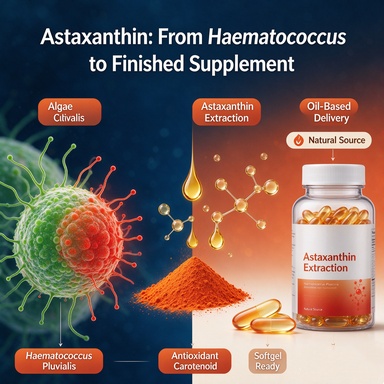
Astaxanthin (3,3′-dihydroxy-β,β-carotene-4,4′-dione, CAS 472-61-7) is a red ketocarotenoid of the xanthophyll class and one of the most potent lipid-phase antioxidants found in nature. The commercial material is produced from the green microalga Haematococcus pluvialis, which accumulates astaxanthin as mono- and di-esters when it is stressed by nutrient depletion and high light. Baisifu supplies 1 percent, 2 percent, 5 percent and 10 percent grades for skin-ageing, eye-health and antioxidant formulations, with the ester profile and the carotenoid HPLC fingerprint on every COA.
Production and origin
The alga is cultivated in closed photobioreactors and open raceway ponds, then induced to encyst so that the carotenoid accumulates; the biomass is harvested, dried and extracted with food-grade solvent or supercritical CO2. Baisifu standardises the oleoresin and the beadlet powder to a fixed astaxanthin content and records the cultivation site and the extraction route on the Statement of Origin, so buyers can separate algal material from the synthetic or fermentation routes that are sometimes offered under the same name.
Identity and assay
Astaxanthin is assayed by HPLC at 478 nm against an astaxanthin reference standard, with the mono-ester, di-ester and free-form distribution reported for oil-based grades. The standard specification is a minimum of 1 percent or 10 percent total astaxanthin with the trans isomer dominant, and the COA also records the total carotenoid content so a buyer can see whether the lot is genuinely algal material or diluted with carriers.
Physical behaviour
Astaxanthin oleoresin is a dark red, viscous liquid; the beadlet and powder grades are red to dark-red free-flowing powders. The molecule is highly lipophilic and practically insoluble in water, sensitive to oxygen, heat and light, and it degrades quickly when exposed to air at elevated temperature. Formulations should be protected with antioxidants, packed under nitrogen where possible, and stored away from light and heat.
Applications
Astaxanthin enters the following formulation workflows:
- softgel and capsule supplements for skin-ageing and antioxidant positioning
- eye-health and visual-fatigue research formulations
- women’s healthy-ageing stacks with resveratrol, CoQ10 and vitamin E
- cosmetic actives for antioxidant serums and sun-care emulsions
- functional-food and beverage prototypes (water-dispersible beadlet grade)
Formulation notes
Because astaxanthin is fat-soluble and oxidation-prone, the delivery system does most of the work: dissolve the oleoresin in a lipid carrier for softgels, or use beadlets for dry blends and beverages. Add the carotenoid last in the process, keep the temperature below 60 degrees Celsius, and pair it with tocopherols or ascorbyl palmitate to protect the colour and the activity during shelf life. In emulsions, expect a light pink to orange tint at use levels, which some brands use as a visual cue.
Certificate of Analysis
Each lot ships with a COA recording:
- total astaxanthin assay by HPLC
- ester distribution and trans/cis ratio
- total carotenoid content
- heavy metals (Pb, As, Cd, Hg) and residual solvents
- microbial count with specified pathogens
- peroxide value for oil-based grades
Regulatory and handling
Astaxanthin is supplied as a raw material for nutraceutical, functional-food and cosmetic formulation. It is not a drug and makes no drug-level claim. Buyers are responsible for confirming the regulatory status and permitted use level of the finished formulation in the target market. Handle the oleoresin with gloves; it stains skin and clothing strongly.
Packaging and storage
Oleoresin in food-grade drums or aluminium bottles; powder and beadlet grades in double-sealed foil bags within fibreboard drums, 1 kg, 5 kg and 25 kg net. Store cool (below 25 degrees Celsius), dry, protected from light and oxygen; the retest date is 24 months from manufacture when stored as recommended.
Questions
Is your astaxanthin natural or synthetic?
It is algal, from Haematococcus pluvialis, in the esterified form. Synthetic astaxanthin is a different molecule profile and is not what Baisifu supplies for supplement use.
Which grade should a capsule brand choose?
Softgel brands usually take the 5 percent or 10 percent oleoresin; capsule and tablet brands take the beadlet powder. The choice is driven by the fill system and the target label claim rather than by price alone.
How do I protect the colour in a finished product?
Combine the carotenoid with tocopherols, exclude oxygen during filling and store the finished product away from light. Colour fade in a stability study is usually an oxidation signal rather than a raw-material defect.
Request a quotation
Send Baisfu the required grade, delivery format and quantity, and the sales desk will reply with a current price, the lot fingerprint, packing option and lead time, with pre-shipment samples from the quoted lot.
Need specifications, COA, or a wholesale quote? Contact Us — typical response within 24 hours.