
Chasteberry for PMS and Cycle Support: A Formulator’s Guide to Vitex Standardisation
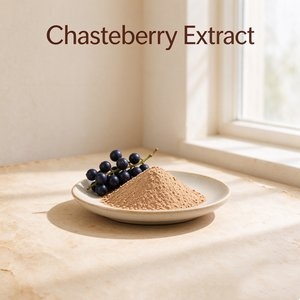
Chasteberry is the most widely used botanical in premenstrual and cycle-support products, and also one of the most loosely specified. Buyers routinely order “chasteberry extract 0.5%” without knowing whether the marker is agnuside or vitexin, whether the material is fruit-only or fruit-plus-leaf, or which part of the plant the assay actually reflects. Those three details decide whether two products with identical labels behave the same way in the body — so they deserve more attention than the price per kilogram.
What the Fruit Actually Contains
First of all, the active part is the dried ripe fruit of Vitex agnus-castus, a Mediterranean shrub in the Lamiaceae family. The fruit carries two analytically useful marker families: the iridoid glycosides, dominated by agnuside and aucubin, and the flavonoids, dominated by vitexin and casticin. Commercial extracts are usually standardised on agnuside at 0.5 percent, or occasionally on vitexin, and the two specifications are not interchangeable — a 0.5 percent agnuside extract and a 0.5 percent vitexin extract can come from very different raw materials and carry very different amounts of the other constituents.
The traditional and modern positioning of the plant is hormonal balance rather than hormone replacement: it is used in products aimed at premenstrual comfort, cycle regularity and the general “hormonal balance” language that dominates the category. That positioning is what makes the marker question commercial rather than academic, because the label claim a brand builds will reference the marker it chose.
The Leaf-and-Stem Problem
Furthermore, chasteberry is one of the botanicals where substitution is easy and common. The fruit is expensive to harvest and dry; the leaf and stem are not. Leaf material carries a different iridoid profile, is visibly different under microscopy, and shifts the ratio between agnuside and the other constituents — but a supplier who blends leaf into a fruit extract can still hit a 0.5 percent agnuside number by adjusting the blend.
The defence is straightforward if buyers insist on it: ask for the plant-part declaration on the Statement of Origin, ask for an HPLC fingerprint rather than a single assay figure, and ask whether the extract is standardised from fruit only. A supplier who cannot state the plant part in writing is telling you something.
Extract Ratio Is Not a Specification
Besides that, the “4:1” or “10:1” ratio on a chasteberry quotation is a description of how much dried herb went into the extract, not a measure of what is in the powder. Two 10:1 extracts can differ by a factor of two in agnuside content depending on harvest, solvent and standardisation. Treat the ratio as a starting point for conversation and the marker assay as the actual specification, and require both on the COA.
Harvest timing matters here as well. The fruit is collected in late summer to early autumn when the iridoid content peaks, and late-harvest or immature fruit gives a lower agnuside yield that has to be compensated for during standardisation. A supplier who contracts the harvest window, rather than buying spot fruit, gets a more consistent extract — which is the difference between a specification that holds in February and one that does not.
Where Chasteberry Sits in a Formulation
Meanwhile, the practical dose range in commercial products sits between 20 and 40 mg of a 0.5 percent extract per day, which is small enough that the extract usually sits in a capsule alongside other actives rather than carrying a product on its own. The most common architecture is chasteberry plus evening primrose for the premenstrual positioning, and increasingly chasteberry plus red clover isoflavones for the broader “hormonal balance across the cycle” story that midlife consumers respond to.
Two formulation notes are worth passing to your R&D team. Chasteberry is a dry extract with a strong, slightly peppery taste, so it belongs in capsules or coated tablets rather than chewables. And because products in this category are usually positioned for daily use over consecutive cycles rather than for immediate effect, the packaging and the pack size should support a multi-month regimen — a 30-capsule bottle undermines a product whose story is “give it two to three cycles”.
What to Put in the Specification
Finally, the specification should be short and unambiguous: plant part (fruit), marker (agnuside or vitexin, stated explicitly), assay method (HPLC), the marker content range, the extract ratio as supplementary information, loss on drying, heavy metals, microbiology and pesticide residues. Pesticide testing matters more for this plant than for many others because the fruit is harvested from shrubs that are sometimes grown without the residue controls used in food crops.
Baisifu supplies chasteberry extract standardised on agnuside from fruit-only material, with the plant part, the HPLC fingerprint and the pesticide panel on the COA. If your formulation sits in the premenstrual or cycle-support space, send the marker you intend to claim and the annual volume, and the technical desk will match the grade to the claim rather than to the catalogue. The full range of actives for this positioning is listed in the women’s health programme.
Need a botanical ingredient partner?
COA, samples and RFQ quotations — reply within one business day.