
Ergothioneine CAS 497-30-3 | Baisfu
What the compound is
Ergothioneine (CAS 497-30-3) is a naturally occurring amino acid derivative (2-mercapto-L-histidine betaine) found in mushrooms, grains and the mycelium of certain fungi. It is a stable thiol antioxidant with a unique tautomeric form (thione-thiol) that resists auto-oxidation; the researched profile supports antioxidant, skin-care and cellular-health formulations.
Origin and production
Ergothioneine is produced by microbial fermentation using Mycelia sterilia or Pleurotus ostreatus strains, or by chemical synthesis from L-histidine. Baisifu offers fermentation-derived and synthetic grades; the Statement of Origin identifies the production route and the production batch.
Identity and assay
Baisifu standardises the material in-house by HPLC against a reference ergothioneine standard; the standard assay grade is 98.0 percent ergothioneine (HPLC, area normalisation). The full identity profile, including specific rotation, is recorded on each COA.
Physical behaviour
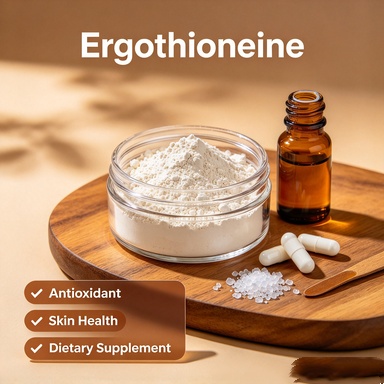
The material is a white to off-white crystalline powder with no characteristic odour; it is freely soluble in water, slightly soluble in ethanol and insoluble in ether. The aqueous solution is neutral (pH of a 1 percent solution is approximately 6.5 to 7.5); the thione form is stable at neutral pH and does not auto-oxidise like conventional thiols.
Applications
Ergothioneine enters the following formulation workflows:
- cosmetic skin-care actives (antioxidant and cellular protection)
- nutraceutical and dietary supplement capsules (antioxidant support)
- ophthalmic and research-grade formulations
- functional-food and beverage fortification
- cell-culture and antioxidant-assay standards
Formulation notes
Ergothioneine is distinguished from glutathione and cysteine by the thione-thiol tautomerism: at physiological pH the thione form predominates, which does not auto-oxidise or form disulphides. This makes the compound suitable for aqueous formulations with long shelf-life. In capsule grades the compound is blended with maltodextrin; in cosmetic formulations it is used at low use levels (0.1 to 1 percent).
Certificate of Analysis
Each lot ships with a COA recording:
- ergothioneine assay by HPLC (area normalisation)
- specific rotation (identity)
- related-compound profile
- loss on drying and residue on ignition
- heavy metals (Pb, As, Cd, Hg)
- microbial count and specified pathogens
Regulatory and handling
Ergothioneine is supplied as a cosmetic and nutraceutical raw material; it is not a drug and makes no drug-level claim. Buyers are responsible for confirming the regulatory status of the finished formulation in the target market. Handle with gloves and eye protection; avoid inhalation of the dust.
Packaging and storage
Supplied in double-sealed food-grade polyethylene bags within fibreboard drums, under nitrogen, 1 kg, 5 kg and 25 kg net. Store in the original sealed container at room temperature, dry, protected from light; the retest date is 36 months from manufacture when stored as recommended.
Questions
How is ergothioneine different from glutathione?
Ergothioneine is a thione (not a thiol) at physiological pH and does not auto-oxidise or form disulphides, unlike glutathione. This makes it more stable in aqueous formulations with long shelf-life.
Is it natural or synthetic?
Baisifu offers both fermentation-derived and synthetic grades. The production route is stated on the COA.
Can it be used in food?
Ergothioneine is supplied as a raw material; the regulatory status for food use varies by market. Some markets classify it as a novel food ingredient. Confirm the permitted use level and any required notification with the target-market regulator.
Request a quotation
Send Baisfu the required ergothioneine standard and quantity, and the sales desk will reply with a current price, the lot fingerprint, packing option and lead time, with pre-shipment samples from the quoted lot.
Need specifications, COA, or a wholesale quote? Contact Us — typical response within 24 hours.