
Sodium Hyaluronate CAS 9067-32-7 | Moisturizing Raw Material – Baisfu
What the compound is
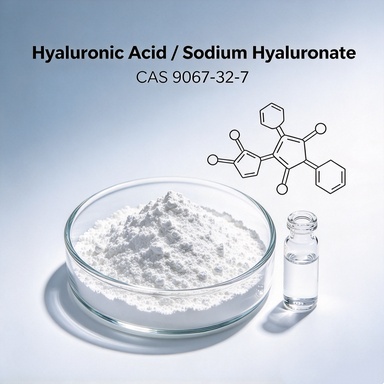
Sodium Hyaluronate (CAS 9067-32-7) is the sodium salt of hyaluronic acid, a linear glycosaminoglycan composed of repeating disaccharide units of N-acetyl-D-glucosamine and D-glucuronic acid. It is a natural component of skin, synovial fluid and connective tissue; the researched profile supports moisturising, viscoelastic and joint-health formulations across cosmetic, nutraceutical and medical-device grades.
Origin and production
Sodium hyaluronate is produced by microbial fermentation of Streptococcus equi subsp. zooepidemicus or other GRAS strains, followed by downstream purification, precipitation and molecular-weight control. Baisifu offers cosmetic-grade, food-grade and research-grade material; the Statement of Origin identifies the fermentation strain and the production batch.
Identity and assay
Baisifu standardises the material in-house by HPLC and carbazole assay against reference markers; the standard assay grade is 95.0 percent sodium hyaluronate (dry basis), with molecular-weight grades ranging from low (20 to 50 kDa, cosmetic), medium (100 to 300 kDa, multi-purpose) to high (1000 to 2000 kDa, viscoelastic). The full identity and molecular-weight profile is recorded on each COA.
Physical behaviour
The material is a white to off-white fibrous or amorphous powder with no characteristic odour; it is freely soluble in water (forming a clear, viscoelastic solution) and insoluble in ethanol, ether and organic solvents. The aqueous solution viscosity is molecular-weight-dependent; low-MW grades give low-viscosity solutions, high-MW grades give high-viscosity gels.
Applications
Sodium Hyaluronate enters the following formulation workflows:
- cosmetic skin-care actives (moisturising and viscoelastic)
- nutraceutical and dietary supplement capsules (joint-health support)
- medical-device and viscoelastic research prototypes
- ophthalmic and wound-care formulations (research-grade)
- functional-food and beverage systems (low-MW grades)
Formulation notes
The molecular weight is the principal formulation variable; low-MW grades penetrate the stratum corneum and are used in serums and essences, medium-MW grades are used in creams and lotions, and high-MW grades form surface films and viscoelastic gels. Avoid co-formulation with strong cationic polymers and strong oxidisers; the glycosidic bond is stable at neutral to mildly acidic pH. Do not autoclave high-MW grades (thermal chain scission).
Certificate of Analysis
Each lot ships with a COA recording:
- sodium hyaluronate assay (dry basis)
- molecular-weight distribution (by GPC/SEC)
- protein and nucleic-acid residual
- loss on drying and residue on ignition
- heavy metals (Pb, As, Cd, Hg)
- microbial count, endotoxin and specified pathogens
Regulatory and handling
Sodium Hyaluronate is supplied as a cosmetic, food and research raw material; the grade determines the permitted use. Cosmetic-grade is for topical use only; food-grade is for oral consumption; medical-device or ophthalmic grades require additional compliance. Buyers are responsible for confirming the regulatory status of the finished formulation in the target market. Handle as a fine powder with gloves and eye protection.
Packaging and storage
Supplied in double-sealed food-grade polyethylene bags within fibreboard drums, 100 g, 500 g, 1 kg and 5 kg net. Store in the original sealed container at 2 to 8 degrees Celsius, dry; the retest date is 36 months from manufacture when stored as recommended.
Questions
What molecular weight do I need?
Low-MW (20 to 50 kDa) for penetrating serums, medium-MW (100 to 300 kDa) for creams and lotions, high-MW (1000 to 2000 kDa) for viscoelastic gels and surface films. Specify the required MW range when ordering.
What is the difference between cosmetic and food grade?
Cosmetic grade is for topical use; food grade meets additional purity and microbial standards for oral consumption. Medical-device and ophthalmic grades require further compliance. The grade is stated on the COA.
Is it animal-derived?
No. Baisifu sodium hyaluronate is produced by microbial fermentation, not by extraction from animal tissue (rooster comb or umbilical cord). The fermentation source is stated on the COA.
Request a quotation
Send Baisfu the required sodium hyaluronate standard, molecular weight and quantity, and the sales desk will reply with a current price, the lot fingerprint, packing option and lead time, with pre-shipment samples from the quoted lot.
Need specifications, COA, or a wholesale quote? Contact Us — typical response within 24 hours.