Dong Quai in Modern Women’s Formulations: Ligustilide, Sulfur and the TCM Quality Problem
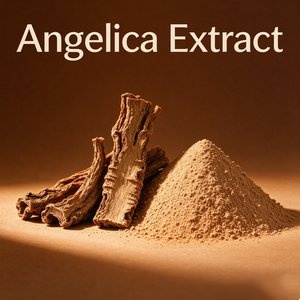
Dong quai has been the central women’s herb of Chinese medicine for well over a thousand years, and it is now one of the few traditional actives that Western supplement brands buy with genuine confidence — because the molecule is identifiable, the supply chain is mature and the story writes itself. It is also one of the most technically awkward botanicals in the women’s range, for reasons that have nothing to do with tradition and everything to do with sulfur, volatility and the difference between a water extract and an oil.
What Makes the Root Different From Other Women’s Botanicals
First of all, dong quai (Angelica sinensis, Apiaceae) is a volatile-oil plant, not a saponin or flavonoid plant. Its characteristic constituents are the phthalides — ligustilide above all, with butylidenephthalide and senkyunolide alongside — plus ferulic acid and polysaccharides. The phthalides are what give the root its distinctive aroma and much of its traditional identity, and they are also what makes the material unstable: ligustilide is heat-labile, oxidises readily and is lost during aggressive drying or prolonged storage.
That single fact explains most of the quality variation in the market. A dong quai extract standardised to 1 percent ligustilide is a different product from one standardised to 1 percent ferulic acid, even though both are sold as “dong quai extract 1 percent” on a quotation.
The Sulfur Problem
Furthermore, the root is traditionally sulfur-fumigated after harvest to prevent mould and insect damage during storage. Sulfur fumigation is cheap and effective, and it also converts some of the phthalides into their sulfonate derivatives, reduces the volatile-oil content and leaves sulfur dioxide residue in the finished extract. Several markets now restrict SO2 residues in herbal materials, and a brand that has not asked the question will not know whether its dong quai was fumigated.
The question to ask is direct: was the root sulfur-fumigated, and what is the SO2 residue on the COA? A supplier who tests for it can answer in a day; one who has never been asked usually cannot. Air-dried or low-temperature-dried root costs more and produces a fuller phthalide profile — which is why the price gap between two “identical” extracts is often larger than the market expects.
Extract Type Decides the Marker
Besides that, the extraction route determines what can be claimed. A water or hydro-alcoholic extract concentrates ferulic acid and polysaccharides and carries relatively little of the volatile oil; a steam-distilled or supercritical route concentrates the phthalides. If the label claim is ligustilide, the material must come from a route that preserves the oil; if the claim is a traditional 10:1 extract, the marker may be ferulic acid and the phthalide content may be incidental.
This is not a technicality. Two dong quai products can carry the same herbal name and behave completely differently in a capsule, and the difference is visible only in the chromatogram.
Where It Sits in a Modern Formulation
Meanwhile, the commercial positioning has shifted. Dong quai is no longer sold mainly as a single-herb product; it appears in women’s wellness blends aimed at cycle comfort and general “blood-nourishing” positioning, usually alongside chasteberry for the cycle angle, puerarin for the Asia-facing formulae, and increasingly isoflavones where the brand wants a phytoestrogen story alongside the traditional one.
Two formulation constraints are worth flagging. The taste and aroma are strong, so capsules and coated tablets are the practical formats; and because the phthalides are volatile, the finished product needs a moisture and oxygen barrier rather than a standard blister. Products that skip this step often show a declining ligustilide assay over shelf life without any change in appearance.
The Regulatory Line
Finally, dong quai sits on a regulatory boundary that varies by market: in some jurisdictions it is a food ingredient with permitted traditional-use wording, in others a herbal medicinal product requiring a registration route, and in others a novel or restricted botanical. That means the same formula may be a supplement in one market and a medicine in another, which is why the documentation pack — species, plant part, extraction route, marker, residues — matters before the formula is finalised rather than after.
What to Specify
Species and plant part (root), extraction ratio and route, the marker system (ligustilide by GC or HPLC, ferulic acid by HPLC, or both), sulfur dioxide residue, pesticide residues, heavy metals, and the volatile-oil content where a phthalide claim is intended. Add a stability note to the finished-product specification, because the raw-material COA tells you what arrived, not what will still be there in eighteen months.
Baisifu supplies dong quai extract with the species, plant part, extraction route and SO2 residue declared, and can quote both the ferulic-acid-standardised and the ligustilide-standardised grades so the specification matches the claim. The rest of the actives for traditional and modern women’s formulations are listed in the women’s health programme.
Need a botanical ingredient partner?
COA, samples and RFQ quotations — reply within one business day.